
- Knowledge Centre
- Acupuncture research
- Databases
- Guidelines
- Evidence Based Medicine
Acupuncture in Cancer

Research shows that acupuncture can be an effective treatment for people with cancer. Acupuncture is used as a complement to conventional treatment and focuses on reducing side effects of standard medical treatment and/or on recovery afterwards.
Scientific Research
A great deal of scientific research has been conducted on the application of acupuncture in cancer patients. If you search the PubMed website for scientific studies on 'acupuncture and cancer' and limit yourself to Randomised Controlled Trials (RCT), Meta-Analyses, and Systematic Reviews from the last 20 years, you will find approximately 900 articles.
The strongest evidence exists for CINV (Chemotherapy-Induced Nausea and Vomiting) and muscle and joint pain associated with aromatase inhibitors. For the other mentioned indications, there are studies with positive outcomes, but more studies are needed.
Here, we have chosen to elaborate on 3 international guidelines in the table below by indication, with references to the articles where you can find more information. In the Netherlands, there is (still) no guideline on complementary care for cancer. Guidelines are based on scientific research (Evidence-Based Medicine) supplemented by the expertise and experiences of healthcare professionals and users (Practice-Based Evidence).
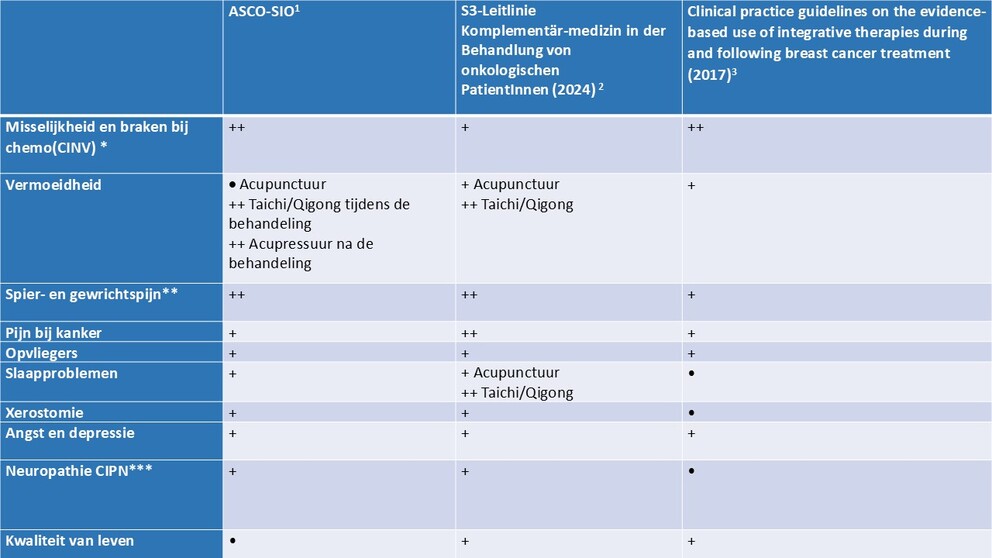
* CINV – Chemotherapy Induced Nausea and Vomiting
* * With Aromatase Inhibitors.
*** CIPN - Chemotherapy Induced Peripheral Neuropathy.
++ Treatment is recommended.
+ Treatment allowed/can be, a certain degree of positive effect is to be expected, but the strength of evidence is not consistent/insufficient for recommendation or e.g. low-quality studies.
• Acupuncture is not mentioned.
1. ASCO-SIO guideline (American Society of Clinical Oncology) - (Society Integrative Oncology) is leading in the field of oncology in the US.
2. German guideline for complementary care in cancer
Also mentioned in the guideline: Ileus/Cognitive impairment: Allowed/can be (+).
3. Clinical guideline for complementary care in women with breast cancer
Side Effects and Safety
A meta-analysis of 65 randomized studies shows that acupuncture poses no increased risk of serious side effects in oncology patients. None of the included studies reported serious acupuncture-related side effects. These findings support the use of acupuncture as a safe complementary therapy for cancer patients. [4]
Acupuncture has a well-documented safety profile, with serious side effects being rare, occurring at an incidence of approximately 0.04-0.08 per 10,000 treatments. Most side effects, such as bruising or fatigue, are mild and transient. [5]
References
1. Society for Integrative Oncology, Practice Guidelines
https://integrativeonc.org/practice-guidelines/
2. S3 Guidelines Complementary Medicine in the Treatment of Oncology Patients, Guidelines Program, DKG Cancer Society, German Cancer Aid, AWMF, version 2.0, 2024 https://www.leitlinienprogramm...
3. Heather Greenlee et al, clinical practice guidelines on the evidence-based use of integrative therapies during and following breast cancer treatment, CA: A Cancer Journal for Clinicians, 2017 Apr 24;67(3):194–232
https://pmc.ncbi.nlm.nih.gov/a...
4. Melanie D. Höxtermann et al, Safety of acupuncture in oncology: A systematic review and meta-analysis of randomized controlled trials, Cancer, Interdisciplinary International Journal of the American Cancer Society, 2022 (June), Volume 128, Issue 11, pp.2041-2204 https://acsjournals.onlinelibrary.wiley.com/doi/epdf/10.1002/cncr.34165
5. Chien-Chen Huang et al, A Review of the Safety and Adverse Events and the Strategy of Potential Risk Prevention, The American Journal of Chinese Medicine, 2024, Vol. 52, No.06, pp. 1555—1587.
https://www.worldscientific.co...
